
History of the GM Side Saddle Gas Tank Defect

The Center for Auto Safety is the nation’s premier independent, member driven, non-profit consumer advocacy organization dedicated to improving vehicle safety, quality, and fuel economy on behalf of all drivers, passengers, and pedestrians.
The side saddle fuel tank design installed in over 10 million trucks – all 1973-87 General Motors full-size pickups and cab-chassis trucks (pickups without beds) and some 1988-91 dual cab or RV chassis – is the worst auto crash fire defect in the history of the U.S. Department of Transportation. Based on data from the Fatality Analysis Reporting System (formerly known as the Fatal Accident Reporting System), over 2,000 people were killed in fire crashes involving these trucks from 1973 through 2009. (Attachment A is a list of fatal C/K fire crashes by state since 1993.) This is more than twenty times as many fatalities as in the infamous Ford Pinto. Despite a voluntary recall request from the National Highway Traffic Safety Administration (NHTSA) in April 1993 (Attachment B) and an initial defect determination by Transportation Secretary Federico Pena in October 1994 (Attachment C), GM stubbornly refused to initiate a recall.
Like Ford and Chrysler, GM made pickups with gas tanks inside the cab in the 1960’s. Because of concerns about the safety of placing the gas tank inside the passenger cab, the Big Three auto makers all considered relocating the tank outside the passenger compartment in the early 1970’s. Chrysler engineers specifically rejected placing the tank outside the frame because of safety concerns saying, “A frame mounted fuel tank mounted anywhere outside the frame rails would be in a very questionable area due to the new Federal Standards requiring 15 MPH side impacts for all vehicles. . . . Any side impact would automatically encroach on this area and the probability of tank leakage would be extremely high.” (Attachment D.)
GM engineers reached a similar conclusion in their early assessments with Chevrolet engineer Alex Mair recommending in 1964 that the fuel tank of the next generation pickup must be mounted outside the cab and as near the center of the vehicle as practical. (Attachment E.) The safety concerns of GM engineers were overridden by management’s sales concerns who wanted to install 40 gallon capacity to get a greater driving
range, and used this as a selling point. The easiest way to achieve a 40 gallon capacity was to install two 20 gallon fuel tanks outside the frame
rail where they were more vulnerable to rupture and puncture by sharp objects in crashes. In 1972, GM engineers recommended to the Vice President for Engineering that if occupants were not killed by crash forces, they “should be free from the hazards of post-collision fuel fires.” (See Attachment F.) After GM management made the decision to place the tanks outside the frame, GM engineers recommended that shields be installed around the tanks to protect them. (Attachment G is an engineering diagram of one GM shield from 1972 while Attachment H is a GM crash test photo of another shield.)

1972 GM Gas Tank Shield Design
GM’s Knowledge of Defect
The problems with the tanks soon became apparent to GM. Within the first year of introduction, GM conducted a special accident study of 1973 compared to pre-1973 pickups which showed “the 1973 trucks had more fuel leaks from the fuel tank than did the pre-1973 pick-ups.” A 1978 study by George Garvil concluded that both the rear located and inside the frame fuel tanks were superior to the outside-the-frame tanks. Using GM’s insurance company Motors Insurance Corp. data, Garvil found “Approximately 40 of 212 or 19%, of the side impacts were judged to have had high fuel tank leakage potential for outboard side-located tanks. Moving these side tanks inboard might eliminate most of these potential leakers.” (See Attachment I.)
After the fatal fire crashes begin mounting up in the mid-late 1970’s, GM again studied alternative designs including moving the tanks inside
the frame, installing a plastic liner or bladder, or using external shields to reduce the danger of tank rupture. (Attachment J is a GM memo considering these options for implementation in 1982 while Attachment K is chart of different inside the frame designs from this memo.) Crash tests of 22 GM pickups in 1981-83 to develop protective designs revealed that the tanks “split like melons.” (Attachment L is a DOT summary description of the GM crash tests and performance objectives for fuel systems.) GM did develop a protective steel fuel tank cage which it installed on its 1978-83 cab chassis models (pickups without the bed). If these cages were modified to fit the C/K pickups it could have significantly enhanced the overall fuel system integrity of the vehicle. GM Vice President Alex Mair sketched a simple shield costing only $23
which was termed “a probable easy fix.” (Attachment M.)
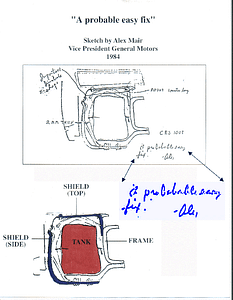
GM Vice President Alex Mair Simple Shield Design
At the heart of GM’s resistance to improving the safety of its fuel systems was a cost benefit analysis done by Edward Ivey which concluded that it was not cost effective for GM to spend more than $2.20 per vehicle to prevent a fire death. (Attachment N.) When deposed about his cost benefit analysis, Mr. Ivey was asked whether he could identify a more hazardous location for the fuel tank on a GM pickup than outside the frame. Mr. Ivey responded, “Well yes…You could put in on the front bumper.” (Video: “Ed Ivey Deposition,” Attachment O is a copy of this portion of the deposition.) GM was able to hide all this evidence and much more from the public until the early 1990’s when leaks in GM’s secrecy dam started and the Center for Auto Safety began to focus in on the defect.

Edward Ivey Memo
DOT’s Deadly Settlement
The battle over the recall of the pickup trucks began on August 14, 1992 when the Center for Auto Safety and Public Citizen filed a recall petition
with the National Highway Traffic Safety Administration (NHTSA) detailing serious fire hazards to owners of the 1973-87 GM pickups. (Attachment P.) GM responded to a NHTSA inquiry prompted by the CAS petition with a 55-page letter and 80 boxes of documents that they argued proved the fuel tank was no danger. Although GM originally claimed confidentiality for this material, it dropped this claim after similar documents were released under the Texas “anti-secrecy” law 76A in Zelenuk v. GM. on December 8, 1992, the NHTSA announced that it would officially investigate the 1973-87 GM pickups.
On April 9, 1993, the NHTSA called on GM to voluntarily recall all of its over 6 million 1973-87 full-size C/K pickups with side saddle fuel tanks. (Attachment B.) In its official response to NHTSA’s recall request, GM refused to comply with the government’s voluntary recall and instead
submitted a 50-page study supporting the safety of its trucks. NHTSA’s recall letter stated, “GM’s fuel tank system in the subject vehicles contains a defect that relates to motor vehicle safety and that GM should therefore initiate a recall of all full-size pick-up trucks and chassis cabs (through the 30/3500 series) sold with fuel tanks mounted outboard of the frame rails.” In its response, GM wrote, “General Motors continues to believe that its 1973-87 C/K trucks are neither defective nor contribute to increased injuries or fatalities. Consequently no safety recall of them is necessary.”
After July 1993, NHTSA continued to gather data with the biggest single revelation being that GM had withheld hundreds of accident reports on
C/K gas tank fires until forced to finally disclose them in February 1994. Secretary Pena required NHTSA staff to give him two option papers, one
for and one against a recall. NHTSA staff were split with the engineers conducting the investigation in favor of a recall and the higher level policy staff recommending against a recall. Because the NHTSA Administrator had recused himself for working as a consultant for GM, the decision fell
to Transportation Secretary Federico Pena.
On October 1, 1994, Secretary Pena made an initial determination that the GM Pickups had a safety defect and that GM had known about the defect since the early 1970’s and had not remedied the defect or warned the public. (Attachment C.) In an accompanying statement, Secretary Pena accused GM management of having “made a decision favoring sales over safety.” (Attachment Q.) Just six weeks later on December 2, 1994, Secretary Pena reversed himself and signed an unprecedented agreement negotiated by high level Justice Department officials with GM to close the GM pickup investigation in exchange for an illusory commitment of $51 million by GM to safety programs.
During these six weeks, GM applied political pressure to force Secretary Pena to fold. on November 3, Rep. Bob Carr from Michigan ordered an investigation by the Inspector General of Pena’s decision. (Attachment R.) On November 10, the Chief Executive Officers of Chrysler, Ford and General Motors wrote President Clinton seeking his intervention to “address the intolerable state of regulatory uncertainty that will otherwise result from Secretary Pena’s decision.” The Big Three CEO’s stressed that Secretary Pena’s decision would have an adverse financial impact on each of their companies and argued that DOT should be prohibited from doing defect recalls where there was an applicable safety standard that the vehicle met. (Attachment S.)
On November 17, GM filed a lawsuit in Federal District Court in Detroit, whose primary purpose was to open the backdoor to the Justice Department for negotiations to scuttle the investigation. General Motors Corp. v. Pena, Civ No. 94-CV-74668 (E.D. Mic., filed Nov. 17, 1994). The Justice Department attorney assigned to the case not only was a former associate from O’Melveny & Myers whose flagship client was Ford Motor Company, he also owned $4,000 of GM stock. More important than owning the GM stock was the fact that the Justice attorney had worked on defending Ford defects while in private practice and knew that the position taken by GM would benefit Ford, his former client, in defense of future cases. On December 2, 1994, GM and DOT settled the case without a recall and with GM agreeing to fund $51.355 million in safety programs. See 60 FR 13752 (Mar. 14, 1995). (Attachment T.)
The Deal
The settlement deal negotiated by the Justice Department was full of flaws and conditions that make it a deadly deal for the American public.
The following are a few examples.
1) The deal prevented DOT from going forward with a public hearing at which extensive new technical information on crash severity and defect
failure modes, new accident data and analyzes showing a much higher death toll, a comprehensive analysis of all GM recalls to show unreasonable risk, new internal GM documents on prior knowledge and inexpensive fixes foregone, and new demonstrative physical evidence and computer simulations would have been presented to make an enforcement proceeding far easier. At a public hearing, DOT could have asked GM for the first time about its $23 “probable easy fix” from 1982; what happened to the 1973 safety shield that was used in the only successful 30-mph crash test for the new C/K pickup; and the ability of bladder liners to stop fuel tank ruptures.
(2) The deal purported to commit GM to spending $51 million on various alternative safety programs to save hundreds of lives. But no documentation showing that these programs had saved hundreds of lives was ever provided. GM did not even have to put up cash but was allowed to put up equivalent facilities, staff and salaries. Moreover, GM was free to spend the money where it wanted. If GM wanted to give public education money to the American Coalition for Traffic Safety, which lobbied to stop the C/K recall, it could do so.
(3) The deal was the very first defect settlement in which no remedy was offered to owners of the defective vehicle. At best, it could be said
that some owners were asked to die so that others might live – but no one consulted the potential victims about whether they wanted to die.

Legal Action
Meanwhile, GM has had to deal with mounting lawsuits from deaths and injuries in fires in these pick-ups. on February 4, 1993 in the trial
of Moseley v. GM, the court found General Motors liable and awarded $4.5 million in compensatory damages and $101 million in punitive damages. This decision, however, was reversed by the Georgia Court of Appeals primarily because the trial attorneys relied on GM testimony to support their claims of other similar incidents (OSI’s) rather than demonstrative OSI evidence. Significantly, the Court went out of its way to say “Considering the public nature of the harm in this case, the corporate defendant herein involved, . . . the amount of the punitive damages assessed against GM was not unreasonable and rationally served the purpose of punishing and deterring.” General Motors Corp. v. Moseley, 213 Ga.App. 875 at 886, 447 S.E.2d 302, 312 (1994). GM settled the Moseley suit rather than face a retrial. At the same time that GM settled Moseley, it settled at least 11 other C/K pickup cases scheduled to go to trial in 1995 for $100 million. The total amount in settlements paid out by GM in C/K pickup fire crashes is over $500 million.
General Motors was also confronted with numerous state class actions, which were consolidated into a Multi-District Litigation (MDL) in the Federal District Court in Philadelphia. The MDL involved 49 states, while a separate state class action continued in Texas. Both class actions were settled by offering $1,000 coupon good towards the purchase of a new GM truck or van to current owners of C/K pickups. The settlements were challenged by the Center for Auto Safety on behalf of individual objectors plus some state and local governments. The Court of Appeals for the Sixth Appellate District of Texas on June 22, 1994 overturned the Texas class action settlement on 1973-87 GM pickups with side saddle gas tanks. Bloyed v. General Motors Corp., 881 S.W.2d 422 (Tex. App. 1994), aff’d, 916 S.W.2d 949 (Tex. 1996). The Court had words for both GM and the Plaintiff Attorneys who got nearly $10 million in hard cash for themselves and paper coupons for consumers. In its stern rebuke, the Court pointed out that the Plaintiffs “instituted this suit because of the hazard posed by the side-saddle gasoline tank, yet this issue is given scant attention in the settlement agreement.”
Lawyers defending the identical settlement for the other 49 states underwent a harsh 4-hour grilling by the US Court of Appeals for the Third Circuit on August 11. Like the Texas Court, the Federal Court questioned the fairness of the national class action settlement and what it did for safety. The Court had serious questions about whether the settlement had any value for consumers, the amount of the attorney fees and the way they were negotiated without notice to the class. In April 1995, the Third Circuit reversed the trial court’s approval of the coupon settlement in a scathing and lengthy page opinion rebuking the court, class counsel, and GM. In re General Motors Corp. Pickup Truck Fuel Tank Prod. Liab. Litig., 55 F.3d 768 (1995, CA3 Pa), cert. den. GMC v. French, 64 USLW 3241 (Oct. 3, 1995). GM’s attempt to obtain Supreme Court review of this decision was rejected in October of 1995. The case went back before the federal trial court for proceedings consistent with the Third Circuit’s order. As discussed below, a state class action moved forward in Louisiana. Members of the federal class filed emergency applications for an injunction to stop the Louisiana class action proceedings. However, the United States District Court for the Eastern District of Pennsylvania denied relief, In re General Motors Corp. Pick-Up Truck Fuel Tank Prods. Liab. Litig., 1996 WESTLAW 683785 (1996, ED Pa), and in January 1998, the Third Circuit affirmed the decision of the district court, holding that such relief was precluded by the principles of personal jurisdiction, the Full Faith and Credit Act, and the Anti-Injunction Act. In re General Motors Corp. Pick-Up Truck Fuel Tank Prods. Liab. Litig., 134 F3d 133 (1998, CA3).
On December 19, 1996, a state court judge in Louisiana approved a new class action settlement covering all GM truck owners. White, et al. v. General Motors Corp., et al., No. 42,865 (Iberville Parish Dist. Ct., December 19, 1996). The settlement includes an improved economic element plus a provision that GM would contribute $4.1 million to a fuel safety research fund but which could not cover C/K pickups, and a stipulation under which the attorneys for the class set up a $1 million research fund to develop and implement a fix for the GM C/K fuel system hazards. Former NHTSA Associate Administrator for Research, Dr. Kennerly Digges, was appointed by the Court as the Independent Trustee for both research projects. on June 29, 1998, the Court of Appeals of the Louisiana First Circuit overturned the second settlement. White v. General Motors Corp., 718 So.2d 480 (La. App. 1 Cir. 1998). A third settlement was then reached which provided that up to $4 million would be added to
the C/K research fund by having $5 from the sale of each of the first 800,000 coupons donated to ensure the manufacture and distribution of the pickup fuel system remedy. The trial court approved the third settlement but issued an order approving a complex mechanism for a $100 cash offer for the right to the $1,000 certificate to be included in the mailing to the class. the Court of Appeals affirmed the settlement in large part but overturned including a cash offer to buy the $1,000 certificate in the class notification. White v. General Motors Corp., 775 So.2d 492 (La. App. 1 Cir. 2000), amended on rehearing, 782 So.2d 9 (2001). Shortly thereafter in a separate appeal, the Court of Appeals approved the trial court’s order that the $4.1 million research program be funded. White v. General Motors Corp., 808 So.2d 722 (La. App. 1 Cir. 2001). Subsequently the trial court approved a new plan to redeem the $1,000 certificate in which the $100 cash offer would be mailed out separately from the class notice. Anyone accepting the cash offer could give a power of attorney to have the $1,000 certificate turned over to class counsel who could then sell it to a third party. Again, the Court of Appeals overturned this plan because the settlement requires the class member to take possession of the certificate.
Dr. Digges formed the Automotive Safety Research Institute (ASRI) to carry out the research and has developed a retrofit inside the frame fuel tank that will successfully withstand a 50 mph side impact from a full size Chevrolet Caprice, a test used by NHTSA to determine the side saddle C/K pickup was defective. (Attachment U, Attachment V and Attachment W are ASRI reports relating to retrofit testing. Video: “NHTSA Crash Test” is the 50 mph NHTSA crash test while Video: “40 MPH Crash Test” is the ASRI 40 mph crash test of the retrofit tank. Video: “Fuel Tank Location” is a comparison of the ASRI retrofit inside the frame fuel tank compare to the original outside the frame fuel tank on a C/K pickup.)
Data updated through 2009 from NHTSA’s Fatality Analysis Reporting System (FARS), show that over 2,000 people have been killed in fire crashes in the U.S. in 1973-87 GM C/K pickups and cab-chassis trucks with the defective outside-the-frame-rail sidesaddle fuel tank design. Just since DOT’s deadly deal with GM to drop its recall efforts in December 1994, over 350 people have died in C/K pickup fire crashes. The side saddle pickup design continues to claim more lives with 5 more crash fire deaths in 2009.
To describe one example, on May 21, 1997, in Carson City, NV, an elderly married couple in a 1978 C/K pickup were both instantaneously immolated when they ran a stop sign at a city intersection and were struck just behind the passenger door by a crossing pickup truck. The fireball resulting from the exploding fuel tank engulfed the other truck as well, and while the 18-year-old driver of the second truck was still conscious when pulled from the burning cab by a witness to the crash, he was burned so severely that his young life ended in a Las Vegas hospital burn unit within the week. Witnesses at the scene recounted that he lay on the ground and was able to ask “Why?” three or four times. The answer to this question, of course, could be found not so much in a Nevada intersection as in Washington, DC and in GM’s Michigan headquarters.